|
| Learning Strategies - Study Skills |
Strategies
Because of the high stakes of testing,
many children with and without special needs become anxious
about taking tests. Preparing children to know what
to expect on the test, how to maneuver the test format, and
how to analyze the questions may help them to become less
anxious and improve performance.
| Test Taking Practice |
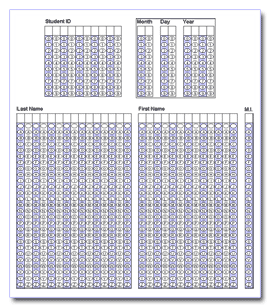
- Some children become overwhelmed with filling in the bubbles on the answer sheets.
Provide opportunities for students to become
acquainted with completing the answer sheets. Catpin Productions offers a free bubble test generator that you can use to create custom bubble tests for students to practice with.
-
Teach
students how to maneuver the test layout.
Show them how to recognize the direction symbols,
bolded information, charts, and highlighted
material.
- If the visual lay out of the test
booklet is too cluttered, encourage
students to fold the booklet so there is only
one page showing at one time. If scratch paper
is allowed, have them cover up the questions
they are not working on to minimize visual distraction.
- Expose children to the different time
allotments. Use regular class
time or independent work to help acclimate to
the time length.
For example:
If they have thirty minutes to work on a section,
monitor the time as if it is a testing session.
- Teach children to recognize the key
words, terms, and common phrases that
are used in tests.
- Often students overlook the stop and start marks so point them
out to the student.
Examples of Common Test Phrasing |
Key Words for Reading:
Main Idea
- This passage is mostly about…
- The central idea is….
View Points
- The author wrote this passage to…
- What is the purpose of the passage …
Specific Details
- According to the passage…
- Give an example of …
Key Words for Mathematics:
Number Sense
- Give the number nearest to
- Round to
- The number greater than, less than,
and/or equal to
- This digit shows the value (For example,
in 345, the 3 holds the place for hundreds,
the 4 holds a place for tens, the 5 for
ones)
Computation
- This number sentence is the same as …
- Which symbol means to ______ (Ex, + or 1)
- In all (sums)
- Find the difference
|
- Practice how to analyze the test questions. Instruct students about the different types of questions.
For example:
- What –
may ask for a concrete response or a specific
detail.
- Why/How –
may be seeking a reason or an inference.
- When –
may ask for a response that refers to historical
time, a specific date or hour, or a general
reference.
- Where –
may ask for a location or a setting.
- Who –
may require a specific name, a character,
or a subject.
- Show students how to make educated guesses.
For example:
- Teach students how
to eliminate unnecessary responses in multiple
choice selections.
- Have them recognize
the wording most commonly used in testing
to support their guessing between two closely
related answers (e.g. ‘all of the time’
versus ‘some of the time’).
- Show students how to
use previous answers or information to guide
responses to subsequent questions.
- When practicing for the test, directly point out how the test is similar to things they learned in class. This will help them to recognize familiar elements and to connect to prior knowledge.
- Guide students to use their problem solving strategies when working with practice problems, such as what type of diagram or pictorial representation will support solving a math problem.
- Provide caregivers information about
the tests, the state’s rules
on testing, scoring, and how to gather samples
about the testing format. Keeping caregivers
informed about the rules and regulations may
help to lessen the stress families feel if they
are uncomfortable with the use and purposes
of the standardized testing scores.
|
|
|